Your Finasteride Is Only Blocking 70% Of Your Hair Loss (Here's What's Still Getting Through)
For men who've been on treatment for months or years and still don't look the way the results suggested they should.

Summary

If you've been dealing with hair loss for a while, you've probably already done more than most men ever do.
You didn't ignore it. You didn't wait. You built a routine.
Finasteride. Minoxidil. Maybe both. Maybe a shampoo. Maybe vitamins on top.
And to be fair — it worked. The aggressive shedding slowed down. Things stabilized. You stopped feeling like you were in free fall.
But something still isn't right.
Not dramatically. Not obviously. But in certain lighting. In photos. When your hair is dry. When you run your hand through it and feel where it used to be thicker.
And the thought creeps in:
If I'm doing everything right — why does it still look like I'm thinning?
The Answer Is Not That Your Treatment Failed
It's that your treatment was never covering the full problem to begin with.
Most men assume that once they're on finasteride, they've handled DHT. It's the logical conclusion. Finasteride blocks the enzyme that produces DHT. DHT is what shrinks hair follicles. Block the enzyme, solve the problem.
But DHT isn't produced by one enzyme.
It's produced by two.
Most men don’t know that an alternative to finasteride exists, that is three times more potent than finasteride and suppresses serum DHT levels by 98% vs. 71% for finasteride (Annals of Dermatology 2022)

The Part Most Men On Finasteride Were Never Told
The body has two versions of 5α-reductase — the enzyme that converts testosterone into DHT. Dermatologists call them Type I and Type II.
Finasteride only blocks Type II.
Type I keeps working. Quietly. In the background. Every day you're on finasteride, Type I is still producing DHT, still reaching your follicles, still causing the miniaturization you started treatment to prevent.
By some estimates, Type I is responsible for up to 30% of total DHT production in men.
Which means if you're on finasteride alone, you're blocking roughly 70% of the problem.
The other 30% never stopped.
Why This Matters More Than It Sounds
At first, 30% doesn't seem catastrophic.
You're still blocking most of it. That's why your results have been real. That's why the hairline firmed up, why the crown stabilized, why the shedding slowed.
But think about it this way:
Imagine you put on sunscreen — but only on 70% of your body.
For the first hour, everything looks fine. You're protected in most places.
But the longer you're out there, the more the exposed skin starts to show damage. Not all at once. Not dramatically. Just quietly, consistently, in the spots nothing was ever covering.
That's exactly what's happening on your scalp.
The 30% of DHT that's still being produced continues to work on the follicles that are most vulnerable — the ones that haven't fully miniaturized yet, but aren't strong either. The hairs that determine how dense your hair looks. How full your hairline appears. How your hair sits under harsh lighting.
They're not gone. But they're not fully protected either.
So instead of thickening, they quietly weaken.
And from the outside, it creates the exact impression you've been trying to avoid all along: it looks like you're still losing hair.
Why Most Men Never Address This
Historically, getting a treatment that covered both enzymes wasn't straightforward.
The drug that blocks both Type I and Type II — dutasteride — is FDA-approved, but primarily for prostate issues rather than hair loss. Most general practitioners won't prescribe it for hair. Most dermatologists didn't offer it. And if you wanted a topical version combined with high-concentration minoxidil, you were looking at compounding pharmacies, specialist consultations, and a process most men didn't know existed, let alone pursue.
Moreover, dutasteride is clinically shown to show significantly greater improvement in hair growth compared with finasteride. Dutasteride inhibits type II 5-α-reductase three times more potently than finasteride and suppresses serum DHT levels by 98% (Annals of Dermatology 2022).
So men stayed on finasteride. Or minoxidil. Or both. Assuming they were covered. Wondering why their results plateaued.
Most never found out why.
What Changed Recently
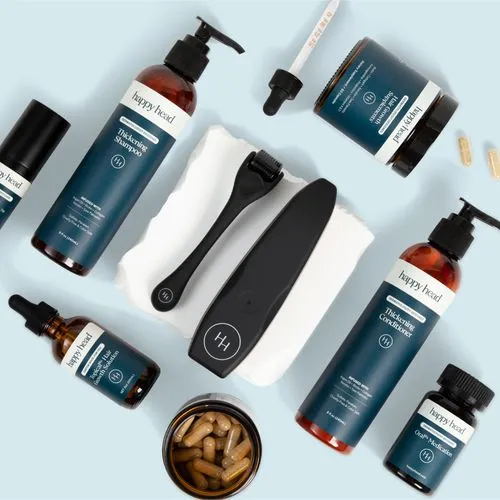
A handful of dermatology-focused platforms have started offering something that used to require a team of specialists: custom-compounded topical formulas, prescribed by board-certified dermatologists, that combine multiple active ingredients into a single daily application.
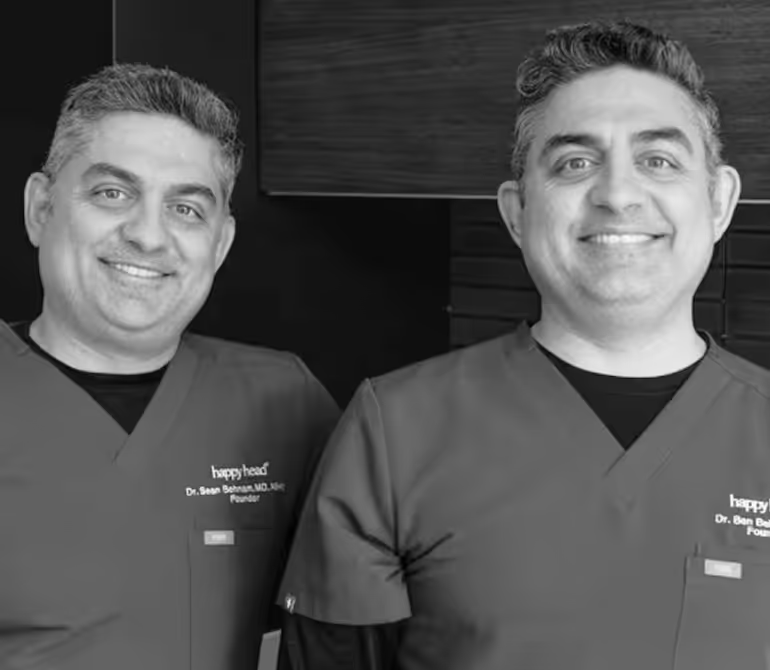
One of them is Happy Head.
Instead of the over-the-counter approach (minoxidil alone, at 5% maximum concentration), Happy Head's dermatologists can prescribe topicals that include:
- Dutasteride — which blocks both Type I and Type II 5α-reductase (the full mechanism your finasteride misses)
- Minoxidil at up to 8% — prescription-strength, 60% more concentrated than what you can buy in stores
- Customized Rx-strength formulas and bases — Happy Head can infuse other proven hair-growth actives like tretinoin, ketoconazole, caffeine, melatonin, cetirizine, latanoprost, biotin, Vitamin D3, across multiple bases including serums and lipodermal delivery systems for potentially lower chances of side effects
All in one topical. Applied once a day. Dermatologist-matched to your specific pattern of loss. Delivered monthly.
This isn't a new molecule or an unproven approach. The individual ingredients are all FDA-approved and well-studied. What's new is the access — being able to get them combined, at prescription strength, without booking a specialist visit every three months.
What This Actually Looks Like In Practice
You complete an online hair assessment — around five minutes, including uploading photos of your scalp.
A board-certified dermatologist reviews your pattern, your history, and your current treatments, then prescribes a formula built for your specific situation — and stays in your corner if anything needs adjusting. If you're already on finasteride, they can build around it. If you've plateaued on minoxidil, they can prescribe a stronger version. If a side effect ever comes up, they can tweak your formula instead of just telling you to stop. And if you've never treated aggressively before, they can start you with something more comprehensive from the beginning.
A board-certified dermatologist reviews your pattern, your history, and your current treatments, then prescribes a formula built for your specific situation. If you're already on finasteride, they can build around it. If you've plateaued on minoxidil, they can prescribe a stronger version. If you've never treated aggressively before, they can start you with something more comprehensive from the beginning.
The first bottle ships to your door within a few days.
You use it once daily. Most men notice early changes — reduced shedding, slightly fuller density — within the first 8–12 weeks. More substantial changes in the 3–6 month range.
From there, it's a monthly subscription. Adjustments can be made at any time based on how your hair is responding.
The Real Question
If you're on finasteride and your results have plateaued — or never quite got to where you thought they would — the question isn't whether your treatment is working.
It probably is. Just not on all of the problem.
The question is whether you're willing to keep leaving 30% of it uncovered.
Because the math of hair loss is unforgiving: the follicles you lose while waiting to make the decision are the ones that don't come back.
Exclusive Reader Offer
$49/Month
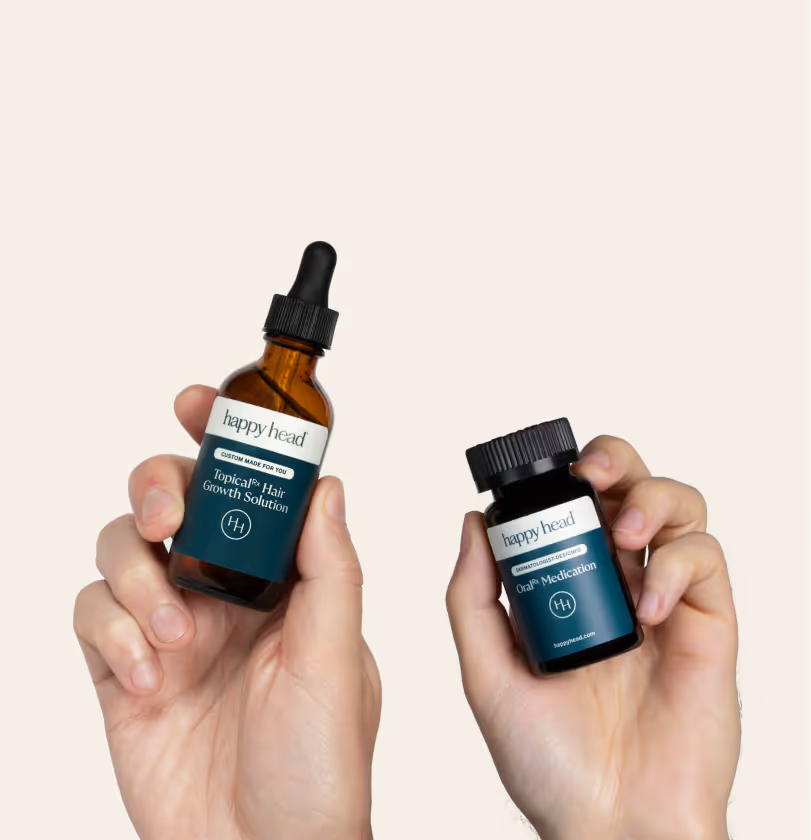
Happy Head — as low as
Happy Head provides personalized, dermatologist-formulated hair loss treatments delivered directly to your door following an online medical consultation.